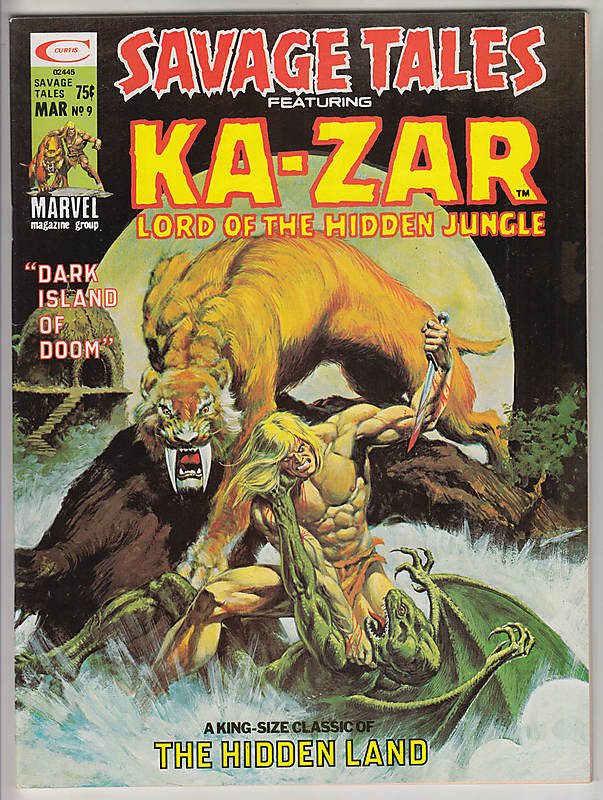
SAVAGE TALES (1971-75) #9
VF+: 8.5
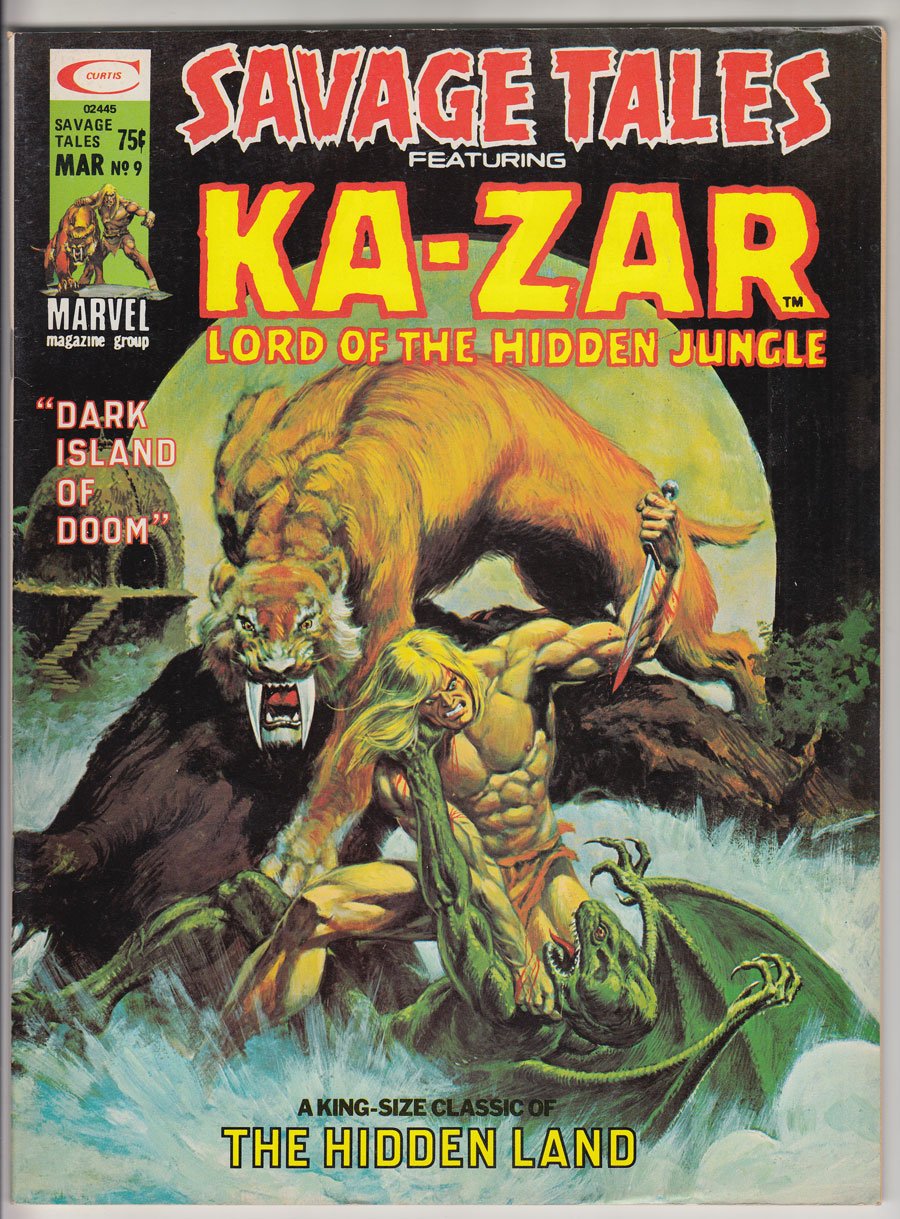
(Stock Image)

DESCRIPTION
Kaluta Ka-Zar cover
Artists Information
Michael William Kaluta is an American comic artist and writer best known for his acclaimed 1970s adaptation of the pulp magazine hero The Shadow with writer Dennis O’Neil. Kaluta's early work included a three-page adventure story, "The Battle of Shiraz", in Charlton Comics Flash Gordon #18 (Jan. 1970) and an adaptation of Edgar Rice Burroughs's Carson of Venus novels for DC Comics. Kaluta's influences and style are drawn from pulp illustrations of the 1930s and the turn-of-the-century poster work of Alphonse Mucha – his signature motif is elaborate decorative panel designs – rather than the comic books of the Silver Age. He has rarely worked with the superhero genre, although one of his early contributions for DC was a "World of Krypton" backup story in Superman #240 (July 1971). His first cover for a comic book was House of Mystery #200 (March 1972). Associated during the 1970s with Bernie Wrightson and Jeffrey Jones, he contributed illustrations to Ted White's Fantastic and Amazing Stories. Kaluta co-created Eve in Secrets of Sinister House #6 (Aug.–Sept. 1972), a horror comics "host" character later turned into a supporting character in The Sandman. He and writer Dennis O'Neil produced a comics adaptation of The Shadow for DC in 1973–1974. Comics historian Les Daniels noted that "Kaluta's style [on The Shadow] is an homage to Graves Gladney, master of the pulp magazine covers of the 1930s." Kaluta left the series after drawing five of the first six issues. Kaluta was one of the four comic book artists/fine illustrator/painters (along with Jeffrey Jones, Barry Windsor-Smith, and Bernie Wrightson) who formed the artists' commune The Studio in a loft in Manhattan's Chelsea district in 1975 and continuing to 1979. In addition to many comic book stories and covers, Kaluta has done a wide variety of book illustrations. Kaluta drew the cover for the Madame Xanadu one-shot in 1981 which was DC's second direct sales only comic. He and writer Elaine Lee crafted Marvel Graphic Novel #13 "Starstruck: The Luckless, the Abandoned and Forsaked" which led to an ongoing series which ran for six issues. Kaluta and O'Neil reunited on The Shadow: 1941 – Hitler's Astrologer graphic novel published in 1988. In 2006, Kaluta was one of the artists on the 1001 Nights of Snowfall graphic novel written by Bill Willingham. In 1984 he drew the illustrations for and directed the music video of "Don't Answer Me" by The Alan Parsons Project, which became one of the most requested videos of the year on the cable video channel MTV. Among music fans, Kaluta is known as the cover artist of Glenn Danzig's instrumental album Black Aria and for the interior illustration of Danzig's fourth album, the latter of which appeared in 1994 and 1995 as a pendant sold at Danzig concerts, and on Danzig T-shirts and sweaters produced in the same period. Kaluta created the CD covers and interior booklet illustrations for Nativity in Black I and II, tribute albums to the music of Black Sabbath. Kaluta drew the cover art for the Bobby Pickett album The Original Monster Mash when it was reissued in 1973.
Mike J. Zeck (born 1949) is an American comic book artist. He is best known for his work for Marvel Comics on such series as Captain America, Marvel Super-Heroes Secret Wars, Master of Kung Fu and The Punisher, as well as the “Kraven’s Last Hunt” storyline in the Spider-Man titles. He attended the Ringling School of Art in 1967 and after graduation worked at the Migrant Education Center in Fort Lauderdale, Florida. Zeck began his comics career in 1974, doing illustration assignments for the text stories in Charlton Comics’ animated line of comics, which led to work on their horror titles. During this period, he lived briefly in the Derby, Connecticut area where Charlton was headquartered. In 1977, Zeck started working for Marvel Comics on Master of Kung Fu with writer Doug Moench. In 2010, Comics Bulletin ranked Moench and Zeck’s work on Master of Kung-Fu sixth on its list of the “Top 10 1970s Marvels.” Zeck later worked on Captain America and drew covers for G.I. Joe: A Real American Hero. Zeck illustrated the Marvel Super-Heroes Secret Wars limited series in 1984. For this series, he designed a new black-and-white costume temporarily worn by Spider-Man. The plot that developed as a result of Spider-Man’s acquisition of the costume led to the creation of the Spider-Man villain known as Venom. In 1986, Zeck collaborated with writer Steven Grant on a Punisher miniseries which was later collected as The Punisher: Circle of Blood and an original hardcover graphic novel of the character three years later. Zeck illustrated the 1987 Spider-Man storyline “Kraven’s Last Hunt” written by his former Captain America collaborator J.M. DeMatteis, which is considered to be one of the quintessential stories in Spider-Man’s history, as well as the definitive Kraven the Hunter storyline. DeMatteis remarked, “Because Mike nailed the plot elements so perfectly in his pencils - every action, every emotion, was there, clear as a bell - I didn’t have to worry about belaboring those elements in the captions or dialogue. I was free to do those interior monologues that were so important to the story. If any other artist had drawn “Kraven’s Last Hunt” ... it wouldn’t have been the same story.” In 2004, Zeck’s cover of Web of Spider-Man #32, which depicts Spider-Man escaping the grave into which he has been interred by Kraven, was recreated as a 12-inch-tall resin diorama statue by Dynamic Forces. Zeck has worked for DC Comics as well. He contributed to Who’s Who: The Definitive Directory of the DC Universe in the mid-1980s. Zeck drew the covers for the “Ten Nights of the Beast” storyline in Batman #417–420 (March–June 1988) and these covers were later collected in a portfolio. His other credits for the publisher include; Batman: Legends of the Dark Knight, Legends of the DC Universe, and covers for Deathstroke, The Terminator. In 1999, he collaborated with writer Mark Waid on The Kingdom (illustrating issue #2, with Ariel Olivetti illustrating issue #1), a sequel to Kingdom Come.
Artists Information
Michael William Kaluta is an American comic artist and writer best known for his acclaimed 1970s adaptation of the pulp magazine hero The Shadow with writer Dennis O’Neil. Kaluta's early work included a three-page adventure story, "The Battle of Shiraz", in Charlton Comics Flash Gordon #18 (Jan. 1970) and an adaptation of Edgar Rice Burroughs's Carson of Venus novels for DC Comics. Kaluta's influences and style are drawn from pulp illustrations of the 1930s and the turn-of-the-century poster work of Alphonse Mucha – his signature motif is elaborate decorative panel designs – rather than the comic books of the Silver Age. He has rarely worked with the superhero genre, although one of his early contributions for DC was a "World of Krypton" backup story in Superman #240 (July 1971). His first cover for a comic book was House of Mystery #200 (March 1972). Associated during the 1970s with Bernie Wrightson and Jeffrey Jones, he contributed illustrations to Ted White's Fantastic and Amazing Stories. Kaluta co-created Eve in Secrets of Sinister House #6 (Aug.–Sept. 1972), a horror comics "host" character later turned into a supporting character in The Sandman. He and writer Dennis O'Neil produced a comics adaptation of The Shadow for DC in 1973–1974. Comics historian Les Daniels noted that "Kaluta's style [on The Shadow] is an homage to Graves Gladney, master of the pulp magazine covers of the 1930s." Kaluta left the series after drawing five of the first six issues. Kaluta was one of the four comic book artists/fine illustrator/painters (along with Jeffrey Jones, Barry Windsor-Smith, and Bernie Wrightson) who formed the artists' commune The Studio in a loft in Manhattan's Chelsea district in 1975 and continuing to 1979. In addition to many comic book stories and covers, Kaluta has done a wide variety of book illustrations. Kaluta drew the cover for the Madame Xanadu one-shot in 1981 which was DC's second direct sales only comic. He and writer Elaine Lee crafted Marvel Graphic Novel #13 "Starstruck: The Luckless, the Abandoned and Forsaked" which led to an ongoing series which ran for six issues. Kaluta and O'Neil reunited on The Shadow: 1941 – Hitler's Astrologer graphic novel published in 1988. In 2006, Kaluta was one of the artists on the 1001 Nights of Snowfall graphic novel written by Bill Willingham. In 1984 he drew the illustrations for and directed the music video of "Don't Answer Me" by The Alan Parsons Project, which became one of the most requested videos of the year on the cable video channel MTV. Among music fans, Kaluta is known as the cover artist of Glenn Danzig's instrumental album Black Aria and for the interior illustration of Danzig's fourth album, the latter of which appeared in 1994 and 1995 as a pendant sold at Danzig concerts, and on Danzig T-shirts and sweaters produced in the same period. Kaluta created the CD covers and interior booklet illustrations for Nativity in Black I and II, tribute albums to the music of Black Sabbath. Kaluta drew the cover art for the Bobby Pickett album The Original Monster Mash when it was reissued in 1973.
Mike J. Zeck (born 1949) is an American comic book artist. He is best known for his work for Marvel Comics on such series as Captain America, Marvel Super-Heroes Secret Wars, Master of Kung Fu and The Punisher, as well as the “Kraven’s Last Hunt” storyline in the Spider-Man titles. He attended the Ringling School of Art in 1967 and after graduation worked at the Migrant Education Center in Fort Lauderdale, Florida. Zeck began his comics career in 1974, doing illustration assignments for the text stories in Charlton Comics’ animated line of comics, which led to work on their horror titles. During this period, he lived briefly in the Derby, Connecticut area where Charlton was headquartered. In 1977, Zeck started working for Marvel Comics on Master of Kung Fu with writer Doug Moench. In 2010, Comics Bulletin ranked Moench and Zeck’s work on Master of Kung-Fu sixth on its list of the “Top 10 1970s Marvels.” Zeck later worked on Captain America and drew covers for G.I. Joe: A Real American Hero. Zeck illustrated the Marvel Super-Heroes Secret Wars limited series in 1984. For this series, he designed a new black-and-white costume temporarily worn by Spider-Man. The plot that developed as a result of Spider-Man’s acquisition of the costume led to the creation of the Spider-Man villain known as Venom. In 1986, Zeck collaborated with writer Steven Grant on a Punisher miniseries which was later collected as The Punisher: Circle of Blood and an original hardcover graphic novel of the character three years later. Zeck illustrated the 1987 Spider-Man storyline “Kraven’s Last Hunt” written by his former Captain America collaborator J.M. DeMatteis, which is considered to be one of the quintessential stories in Spider-Man’s history, as well as the definitive Kraven the Hunter storyline. DeMatteis remarked, “Because Mike nailed the plot elements so perfectly in his pencils - every action, every emotion, was there, clear as a bell - I didn’t have to worry about belaboring those elements in the captions or dialogue. I was free to do those interior monologues that were so important to the story. If any other artist had drawn “Kraven’s Last Hunt” ... it wouldn’t have been the same story.” In 2004, Zeck’s cover of Web of Spider-Man #32, which depicts Spider-Man escaping the grave into which he has been interred by Kraven, was recreated as a 12-inch-tall resin diorama statue by Dynamic Forces. Zeck has worked for DC Comics as well. He contributed to Who’s Who: The Definitive Directory of the DC Universe in the mid-1980s. Zeck drew the covers for the “Ten Nights of the Beast” storyline in Batman #417–420 (March–June 1988) and these covers were later collected in a portfolio. His other credits for the publisher include; Batman: Legends of the Dark Knight, Legends of the DC Universe, and covers for Deathstroke, The Terminator. In 1999, he collaborated with writer Mark Waid on The Kingdom (illustrating issue #2, with Ariel Olivetti illustrating issue #1), a sequel to Kingdom Come.